

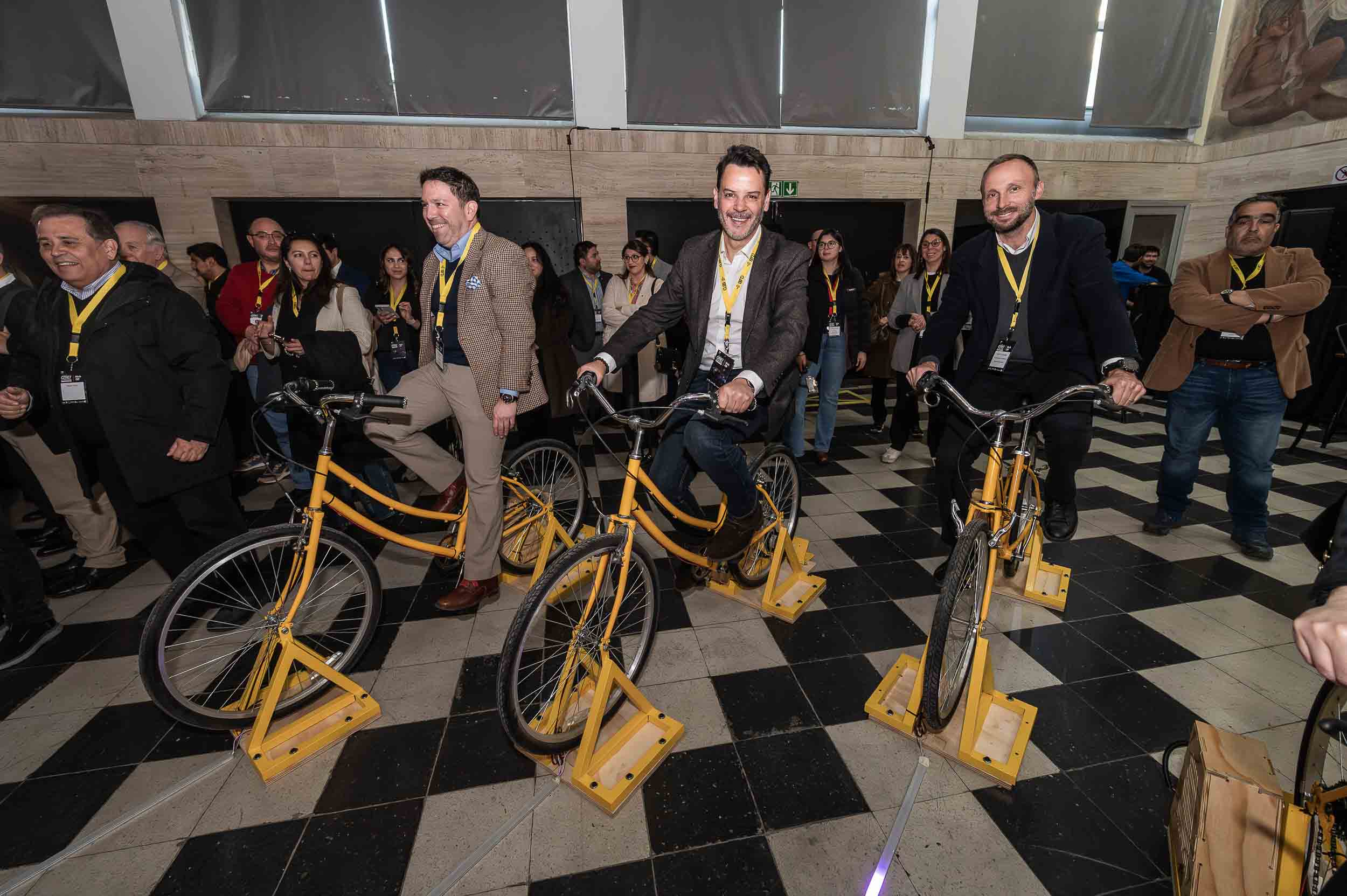
At an event that brought together stakeholders from the public and private sectors, City Lab Biobío unveiled details of the Cities in Transition Summit, which over three days will convene roughly 100 researchers from around the world in Greater Concepción to develop collaborative responses to urban challenges common across different regions of the planet. Event sponsors were also announced, including companies such as Grupo CAP Huachipato and Entel Digital.
What could blockbuster films like “Inside Out,” “WALL-E” and “Toy Story” possibly have to do with Greater Concepción? The answer emerged at a press event held by City Lab Biobío, where organizers revealed the agenda, speakers and details of the Cities in Transition Summit, set for Oct. 7, 8 and 9 in Greater Concepción.
Kristian Norelius, art director at Pixar Animation Studios, and Amy Allen, the studio’s sets design supervisor, will be among the keynote speakers at a community-open event on Wednesday, Oct. 8, when the Teatro Biobío will host a major urban innovation showcase. In addition to a range of exhibitions, attendees will have the opportunity to connect with startups and companies working at the intersection of data, cities and technology. Free registration opened Sept. 11 at citylabbiobio.cl.
With a call to collectively dream up the cities of the future, organizers announced that the October summit will showcase the latest advances in urban research and present findings from five urban challenges facing Greater Concepción in areas including mobility, livability in informal settlements, wildfire prevention and the promotion of healthy living — all grounded in data science. The work has required City Lab Biobío’s technical teams to coordinate throughout the year with counterparts at MIT network urban labs in cities around the world.
“This is a tremendous opportunity for Biobío to engage in conversation with leading researchers and urban planners from around the world in search of solutions for our region. We hope the contributions of these labs from cities across the globe will help address a range of challenges we face,” said Sergio Giacaman, governor of the Biobío Region.
El gobernador regional del Biobío encabezó la cita en que se dieron a conocer los detalles del summit Cities in Transition, encuentro que se desarrolló en el emblemático Salón Mural de esa repartición. Autoridades locales, representantes del mundo académico y empresarial, auspiciadores, instituciones aliadas y medios de comunicación completaron la lista de los convocados a esta actividad.
“We live in a world being rapidly reshaped by science and technology, and that transformation extends to the way we experience our cities. With this summit, we will bring experiences from other parts of the world to tackle longstanding challenges — mobility, wildfires, the environment, informal settlements — through innovation and technology, while also exploring economic development opportunities in the region,” said Fernando Pérez, executive director of City Lab Biobío.
The Cities in Transition Summit is the annual meeting of city laboratories belonging to the MIT network, held in Andorra in 2024 and taking place this year for the first time in a city in the Southern Hemisphere. The event will bring together roughly 100 researchers and professionals working in urban affairs, data technology, AI and science communication, arriving from Hamburg, Germany; Gipuzkoa, Spain; Andorra; Guadalajara, Mexico; Boston; Toronto; Taipei, Taiwan; and Shanghai, China.
“City Lab Biobío has set out to make this an open-door event, inviting everyone who lives in this city to reflect, think and dream about Greater Concepción. From its very beginnings, this city has been built through collective participation — and when we look to the future, it has to be the same way,” said Patricio Donoso, president of Corporación Ciudades.
Attendees also underscored the significance of holding this type of event under the umbrella of MIT, one of the world’s most respected institutions in these fields. “What happens to us as a metro area, as a city, as a region, has also happened in other parts of the world — and they have the experience to address those challenges,” said Bernardo Suazo, past president of the Chilean Chamber of Construction in Concepción.
City Lab Biobío operates in Greater Concepción through the funding and support of the Regional Government of Biobío and the Chilean Chamber of Construction, with Corporación Ciudades managing its day-to-day operations. The lab also receives strategic support from the Universidad de Concepción, Universidad del Bío-Bío and Universidad del Desarrollo, along with partnerships with private companies and public entities. For the Cities in Transition Summit, principal sponsors include Grupo CAP Huachipato and Entel Digital, joined by Essbio, Whoosh, Casa Diseño, MDS Hoteles, Inacap, and the Universidad Santo Tomás and Universidad Andrés Bello.