

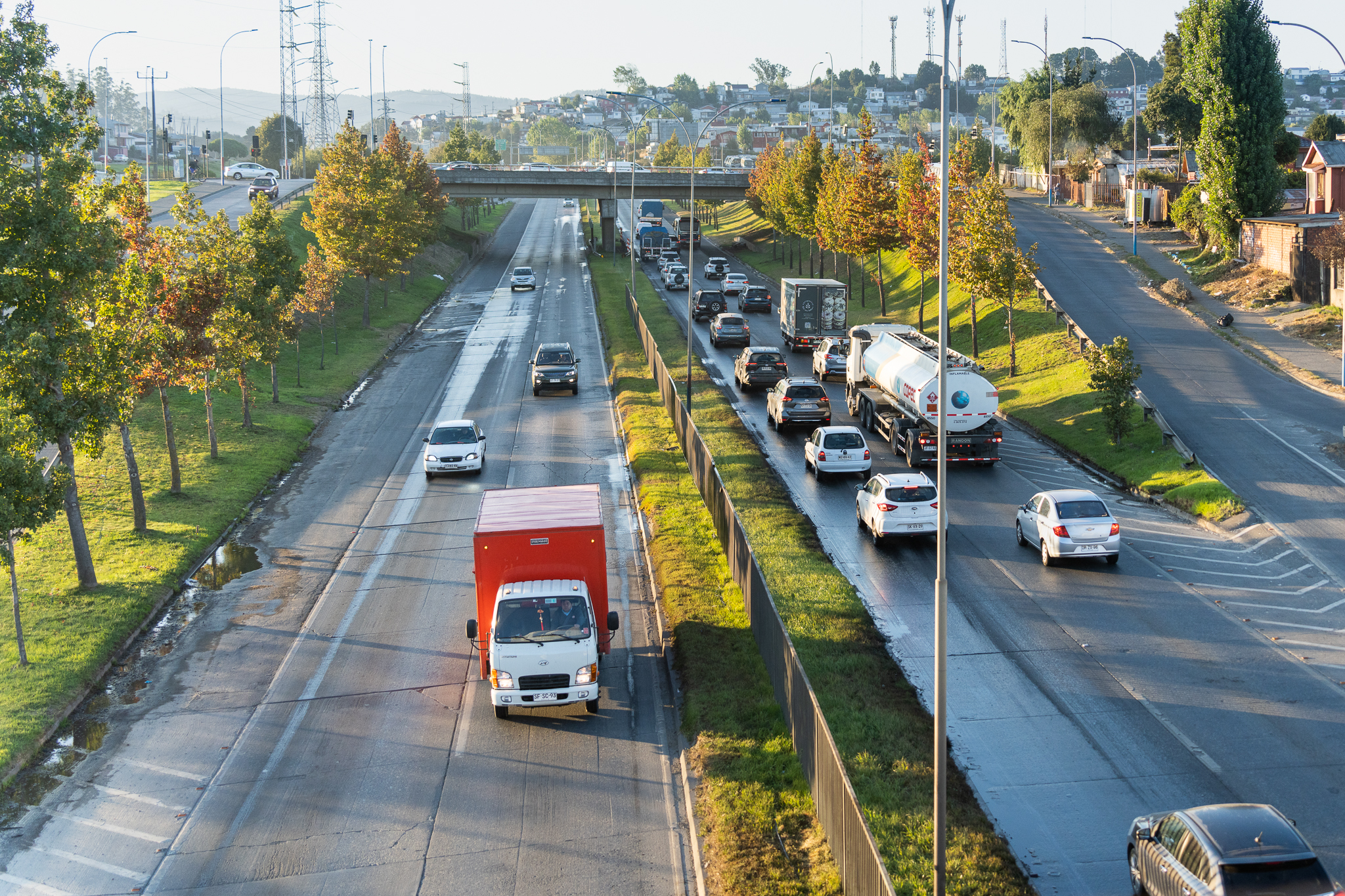
The return to school typically leaves visible traces in cities across the country. A study by City Lab Biobío analyzed the 2025 “Super Monday” to understand how traffic behaved on Monday, March 3, Wednesday, March 5, and Friday, March 7. The analysis found thtat the “return to normality” had a clear impact in Greater Concepción, where more then half of the roads studied showed heavy congestion as the school year began and vacationers returned to their regular routines.
The analysis — which examined 698 road segments using the School Mobility Impact Index (IIEM) across Concepción, San Pedro de la Paz, Chiguayante, and Hualpén — found that 58% of the segments experienced high or very high impact during the first week of March. The study considered factors such as school enrollment, traffic jam length, and delay times.
The study shows that congestion peaks between 7:00 and 9:00 a.m., when students head to school and delays are at their worst. Another key finding is how much the pattern varies over time.
“Los entornos de los establecimientos educacionales son uno de los puntos donde se concentran mayores conflictos de la movilidad durante la mañana. Con este piloto buscamos medir ese fenómeno y evaluar si con soluciones basadas en gestión y no en grandes obras de infraestructura podemos ayudar a disminuir atochamientos”, explica Fernando Pérez, director principal del City Lab Biobío.

Fernando Pérez
Director Principal City Lab Biobío
While Monday marks the start of the peak, the study notes that conditions remain strained throughout the first working days of the month. At the territorial level, Concepción and San Pedro de la Paz show the greatest mobility challenges linked to school travel, largely due to their high concentration of schools and student enrollment.
“Super Monday” began with heavy congestion on Route 160 in both directions, with delays of up to 13 minutes toward Concepción. As the week progressed, delays reached as much as 50 minutes, with speeds dropping below 4 km/h on some stretches.
Downtown Concepción also saw traffic jams stretching up to one kilometer, additional delays of up to 12 minutes, and average speeds of around 18 km/h.
The report calls for targeted strategies in high-impact school zones, including focused infrastructure improvements, traffic signal optimization, the promotion of sustainable transport, and the evaluation of staggered start times at large schools.
It also recommends strengthening continuous monitoring with real-time data to anticipate critical congestion episodes and better inform urban planning decisions.