

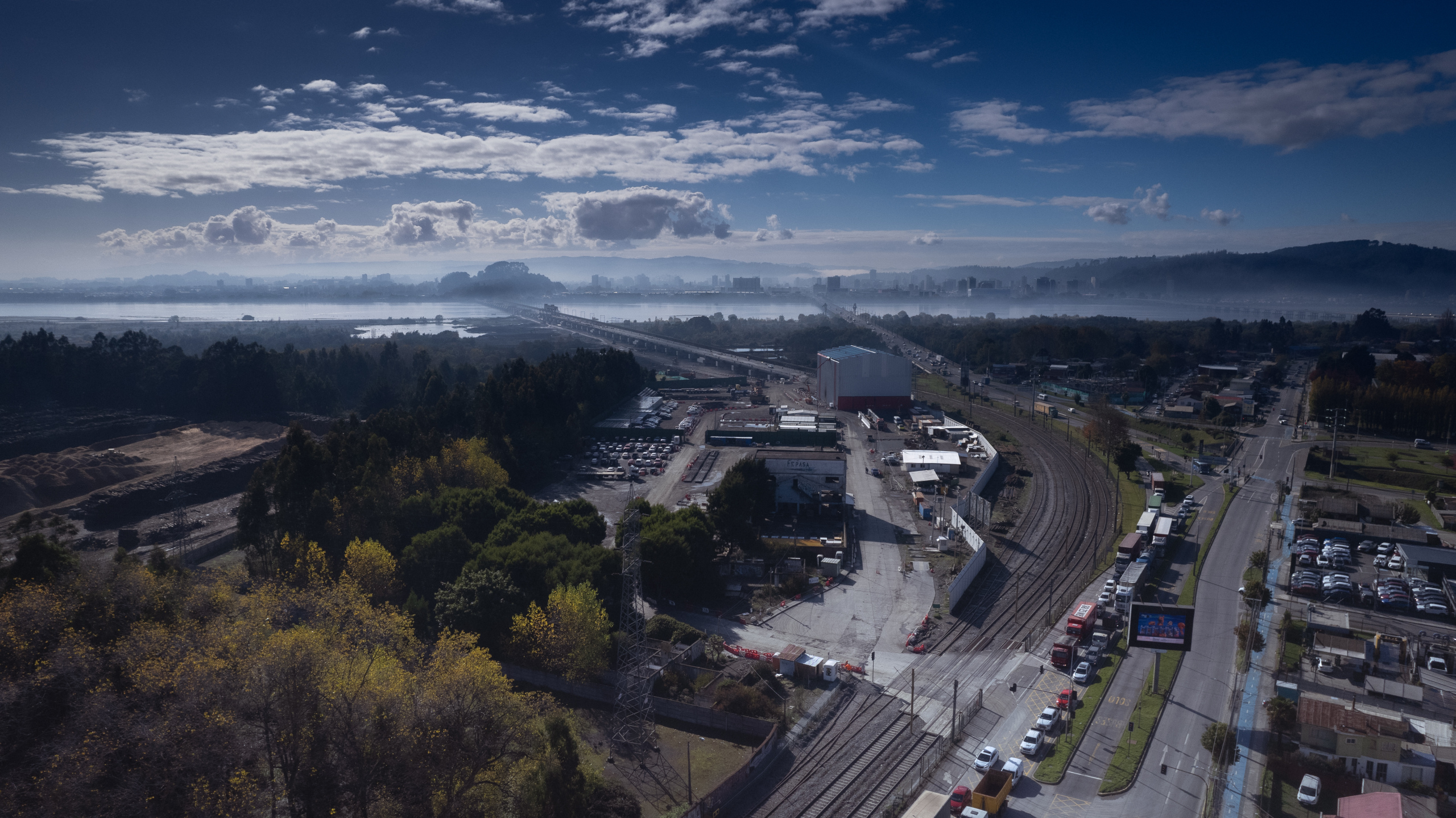
Traffic congestion at all hours of the day — particularly on Route 160, which connects Concepción and Talcahuano with localities south of the Biobío River such as Coronel, Lota, Arauco, Curanilahue, Lebu and Cañete — is one of the main urban challenges facing the municipality of San Pedro de la Paz. For this reason, a range of mobility and urban transport projects are currently in the pipeline with the aim of improving connectivity in the area.
Against this backdrop, and given the possibility of further works arising from projects already approved in the municipality, San Pedro de la Paz will begin working with City Lab Biobío — the city laboratory established in Greater Concepción through the funding and vision of the Regional Government of Biobío and the Chilean Chamber of Construction in Concepción — which uses technology developed by MIT to anticipate the impacts that different urban initiatives may generate.
The agreement was signed by the mayor, Javier Guiñez, and Martín Andrade, executive director of Corporación Ciudades, the body responsible for managing the City Lab Biobío programme. The partnership will produce a transport visualisation platform for San Pedro de la Paz, with the next step being the integration of traffic data from various sources to carry out a dynamic modelling study of traffic flow redistribution following the completion of the planned projects — with the aim of providing relevant data to support decision-making by the authorities and to keep the community informed.
The mayor of San Pedro de la Paz, Javier Guiñez, said: “There are many decisions that will need to be made in light of the investments coming our way, so having this tool will be fundamental for us to understand the effects of those decisions on the population — just as is done in major cities in the developed world — always keeping people at the centre and focusing on the positive effects on their quality of life, in order to promote a modern and sustainable city.”
Martín Andrade, executive director of Corporación Ciudades, highlighted that following the pilot still under development in the Costanera district of the regional capital, the work with San Pedro de la Paz will be the first to address a significant problem in a specific area of Greater Concepción. “This first knowledge transfer will tackle one of the most complex urban challenges facing this community — mobility. This modelling of future projects will allow us to anticipate the challenges that will arise from these works and contribute to guiding and supporting management going forward,” said the architect.
Marcela Martínez, research director at City Lab Biobío, added: “What the laboratory and municipal technical teams will do is bring MIT’s technology down to earth. In this agreement we will look at mobility, but in the future the tool can give us the flexibility to examine other urban challenges in other municipalities, developing new partnerships in territories with projects at development or profile stage, and contributing to their improvement through technology.”