
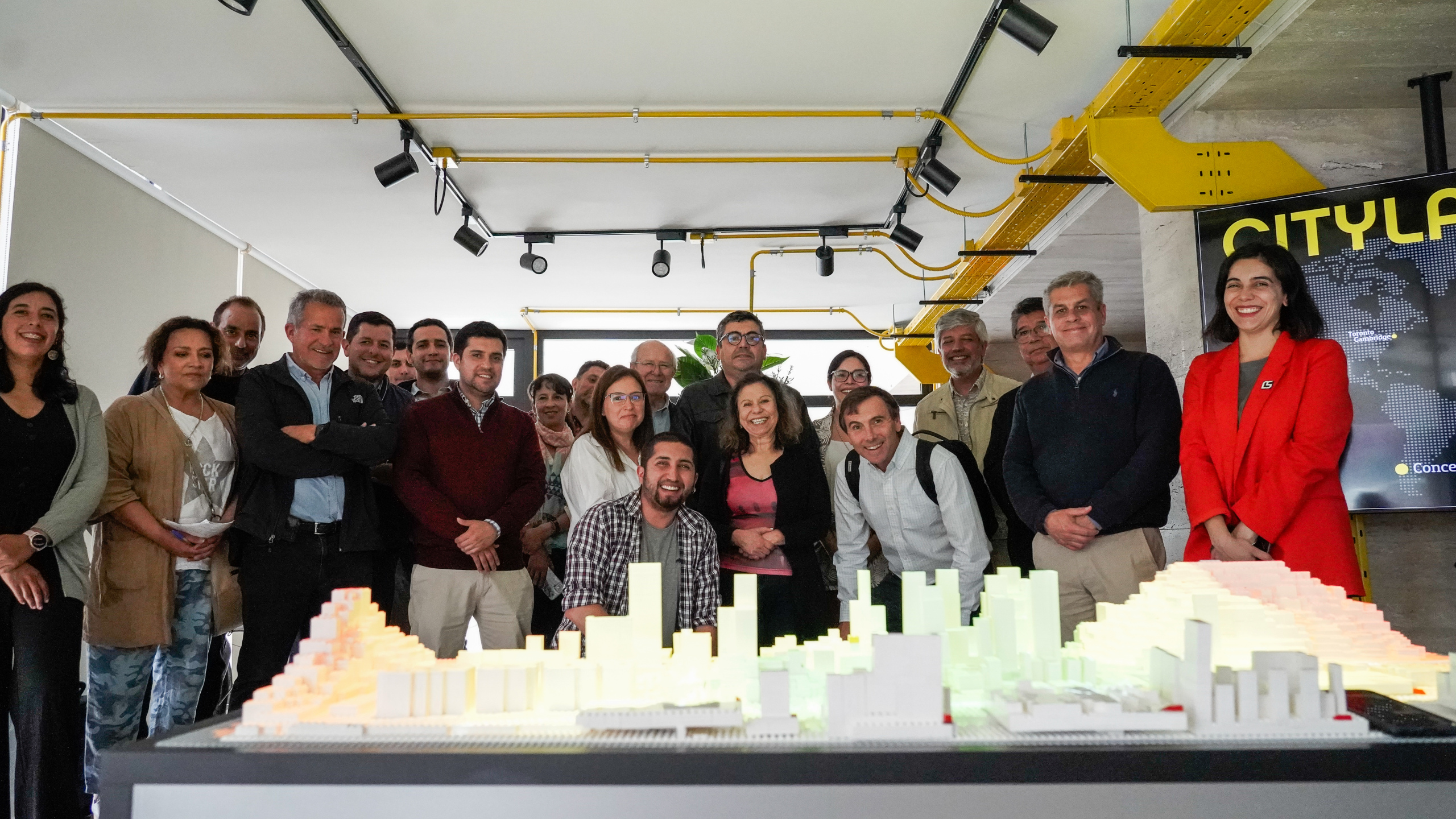
To learn about and explore the functions and potential uses of the interactive platform, three committees of the Chilean Chamber of Construction in Concepción visited City Lab Biobío during January.
The Architecture, Infrastructure and Real Estate working groups met with the laboratory’s team to gain an in-depth understanding of the work carried out during 2023 on the development of the CityScope platform.
The sessions were led by Marcela Martínez, director of City Lab Biobío, who walked each committee through the step-by-step development of the model, which simulates future urban scenarios in the Costanera district.
“Through a data collection strategy we gained access to details of 75 projects planned for the Costanera district of Concepción. To optimise the simulation, we grouped them into seven interactive tiles, which are the ones committee members were able to swap around during their visits,” said Marcela Martínez.
These projects are analysed against four macro-indicators: Density, Diversity, Proximity and Urban Design. The director of City Lab Biobío explained that “each macro-indicator encompasses groups of variables to be studied. Under Density we are looking at population and activity density; under Diversity we are mapping land use types in the study area; under Proximity we are examining access to urban amenities such as culture, green spaces, education, health and services, using the 15-minute walkable city as our benchmark. Finally, under Urban Design we model scenarios relating to cycle lane provision and pavement quality, among other aspects.”
The Chilean Chamber of Construction in Concepción is a key partner of City Lab Biobío and its applied urban research. “Having Chamber members, grouped according to their own interests in these trade committees, enriches the associative and outreach work we are carrying out with key stakeholders in the region,” said Martínez.