

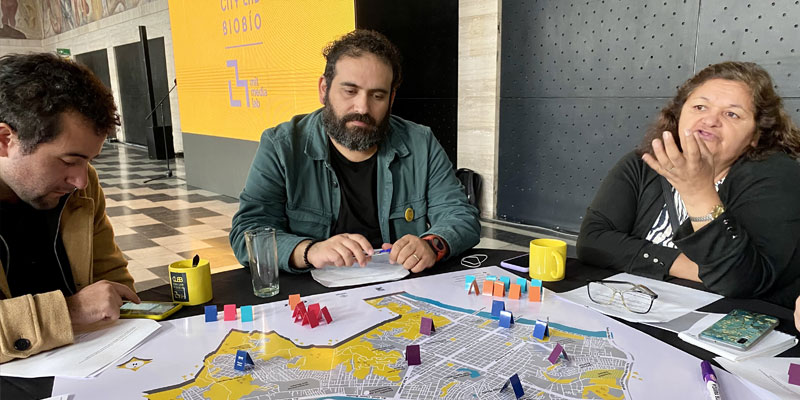
- City Lab Biobío es el nombre del laboratorio vinculado al prestigioso Instituto Tecnológico de Massachusetts (MIT). El proyecto, financiado por el Gobierno Regional y la Cámara Chilena de la Construcción Concepción, y ejecutado por Corporación Ciudades, comenzará a aplicar tecnología e inteligencia artificial para proyectar el impacto de decisiones urbanas en algunos de los barrios penquistas más tradicionales.
Concepción, 12 April 2023. The Biobío River and the railway line are the main boundaries of Concepción’s traditional Costanera district, an area that has historically lagged in urban development and has been the subject of various urban regeneration plans over the past 25 years.
Given its proximity to the city centre, its significance in terms of infrastructure and amenities, its historical trajectory and the various urban interventions it has seen over the years, and following an exhaustive analysis of urban conditions across different neighbourhoods of Greater Concepción, the City Lab Biobío team selected the Costanera district as the first area where an in-depth process of data collection and community engagement will be carried out to develop a modelling process for the territory.
The work will cover three specific neighbourhoods: Pedro del Río Zañartu, Aurora de Chile and Pedro de Valdivia, where various studies are already under way to address issues of housing, transport and public spaces. The modelling of these areas will aim to understand in advance, through simulation, the impact that any urban intervention would generate — allowing decision-makers to anticipate scenarios and improve their choices for these territories.
The announcement of the first pilot neighbourhood was made during the workshop “Challenges and Opportunities for Concepción’s Neighbourhoods,” the first organised by City Lab Biobío, which brought together a range of public and private organisations to analyse the urban difficulties and potential of different areas across the city.
Regional Governor Rodrigo Díaz delivered opening remarks at the start of the event. “We are at the beginning of a process. This is the first working workshop, with representatives from universities and also with residents. It is the first of many participatory spaces we will create to develop intervention models. This is not an incubator for projects in itself, but it is a space for social validation and relevance, grounded in reconciling the interests that communities may have in a neighbourhood. What happens if we widen a street? How do we move forward in harmony with the care of green spaces? These are questions we will answer through serious work, with great care for the people of the Biobío region,” said the regional authority.
Marcela Martínez, director of City Lab Biobío, focused on the impact that incorporating technology already used in other countries can have on the quality of urban decisions. “We are putting science and technology at the service of the city. This is work that will go hand in hand with the vision of neighbourhood organisations, universities and the most diverse range of stakeholders, to carry out neighbourhood-scale, evidence-based urban planning. That is the great contribution to the city that we hope this laboratory’s work will represent,” said the professional leading this project in partnership with MIT.
The first workshop organised by City Lab Biobío and designed by Espacio Lúdico was attended by representatives from the Regional Government of Biobío, the Regional Council, the Municipality of Concepción, the Chilean Chamber of Construction, Corporación Ciudades, Déficit Cero, neighbourhood organisations, trade associations from commercial and productive sectors, academia and regional authorities from various ministries, among others.
This collaborative approach was highlighted by Bernardo Suazo, president of the Chilean Chamber of Construction in Concepción: “There are many organisations, public and private, that interact in the territory. When we all come together with the shared purpose of improving the quality of life and wellbeing of residents, using a proven methodology like the one MIT offers us, the only beneficiaries are the neighbours themselves. I hope this marks the beginning of a very fruitful partnership that allows us to plan the city with a comprehensive, long-term vision,” said the industry representative.
Technology and the City
The City Lab Biobío programme, driven by MIT, the Regional Government of Biobío, the Chilean Chamber of Construction in Concepción and Corporación Ciudades, also counts on the participation of academia, businesses and civil society. Its objective is to strengthen housing planning and sustainable urban development through the implementation of tools and methodologies that enable real-time, to-scale simulations, built from data gathered jointly with communities and relevant public and private stakeholders. To that end it uses CityScope, a platform developed by MIT.
This incorporation of new technologies for better city planning was welcomed by Fernando Pérez, projects director at Corporación Ciudades. “Artificial intelligence is reaching into every area of human activity, and we are going to use it to plan cities better and more efficiently. This is an unprecedented experience that also opens up endless opportunities for other cities, which means many eyes will be on Concepción in the coming years,” said the architect.
City Lab Biobío brought to South America the city laboratory model that MIT also promotes in Andorra, Hamburg, Ho Chi Minh City, Guadalajara, Shanghai, Taipei and Toronto.
Media inquiries with: Enrique Barrera, Cel. +56997420472.