

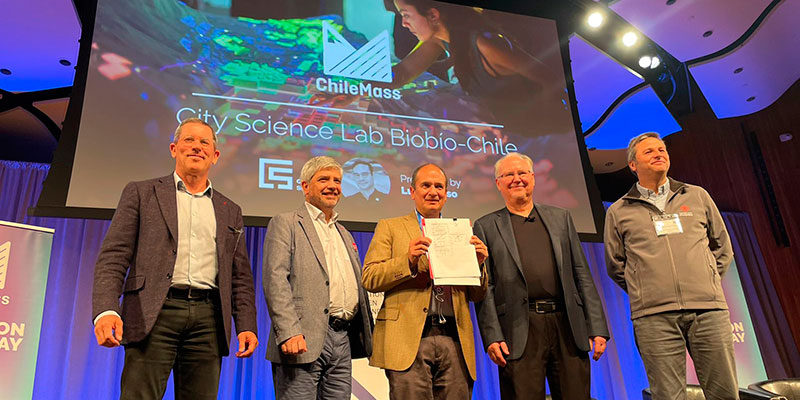
During the first working visit of the City Lab Biobío team to Boston, the Regional Government of Biobío, Corporación Ciudades, the Chilean Chamber of Construction in Concepción and MIT Media Lab’s City Science group formalised the agreement to create South America’s first city laboratory in the Biobío region.
Improving the quality of life of Greater Concepción’s residents through urban planning is the primary objective behind City Lab Biobío, currently being established in the city and surrounding municipalities. The initiative, driven by the Regional Government, the Chilean Chamber of Construction in Concepción and Corporación Ciudades, with the support of three regional universities and various stakeholders, will seek to improve comprehensive urban planning for the city — along the lines of laboratories already operating in Andorra, Hamburg, Ho Chi Minh City, Guadalajara, Shanghai, Taipei and Toronto.
The Innovation Day organised by ChileMass in Boston was the setting in which this working relationship with MIT was formally established, launching a partnership that over the next 48 months will incorporate technology, artificial intelligence and innovation into urban planning across Greater Concepción.
The Biobío regional governor, Rodrigo Díaz, heads the delegation alongside other local authorities. Also taking part are Patricio Donoso, chairman of the board of Corporación Ciudades; Fernando Pérez, the corporation’s projects director; Bernardo Suazo, president of the Chilean Chamber of Construction in Concepción; Helen Martin, the chamber’s former president and a driving force behind bringing MIT to the region; and representatives from the Universidad de Concepción, Universidad del Desarrollo and Universidad del Bío-Bío. The Biobío regional government contingent visiting Boston includes Óscar Ferrel, head of the Infrastructure and Transport Division; Iván Valenzuela, head of the Development and Industry Division; Claudia Toledo, regional ministerial secretary of Housing; and regional councillors Roberts Córdova, James Argo, Patricio Badilla, Ivania Rojas and Brenda Vigueras.
“Having access to a methodology like the one developed by MIT, together with the technology provided by CityScope, will undoubtedly benefit not only Concepción, but also opens up options for incorporating innovation, technology and knowledge into the way we build cities — something that could be replicated by other urban centres in Chile if this proves to be a successful experience,” said Patricio Donoso, president of Corporación Ciudades, speaking from Boston.
The prospect of improving urban conditions for Greater Concepción’s residents — where only 24 per cent live in areas considered high-wellbeing — is one of the points highlighted by Regional Governor Rodrigo Díaz. “Greater Concepción has suffered decades of neglect and poor planning. We can see it across multiple areas: waste, cemeteries, connectivity. The people of the Biobío region cannot keep waiting, which is why as a Regional Government we have forged a partnership that draws on the proven experience of a world-class partner like MIT, together with our friends at Corporación Ciudades. This will help us generate a new industry — one built on knowledge — that we want to share with the rest of the Southern Hemisphere, where this work is also needed. That is our mission as a Regional Government: that is what is achieved when decentralisation moves forward. Taking ownership of our problems, projecting them and solving them,” said the Biobío authority.
City Lab Biobío was presented in August in Concepción. With the working agreement now formalised, the next step will be to develop a governance structure for the project in order to begin systematic, long-lasting work.
“This technology will strengthen territorial planning processes and the methods we apply to ‘build cities,’ taking into account our main priorities in housing, land use and mobility, among others, in order to move towards a more sustainable and smarter Greater Concepción. It will also allow us to understand the impacts on the city’s growth of the various urban decisions made for our territory,” added Bernardo Suazo, president of the Chilean Chamber of Construction in Concepción.
Alongside the signing of the agreement, the first working meeting was held, during which MIT professionals were given a brief overview of the situation in the Biobío regional capital, as well as the main challenges facing a territory where nearly one million people live, 98 per cent of them in urban areas.