

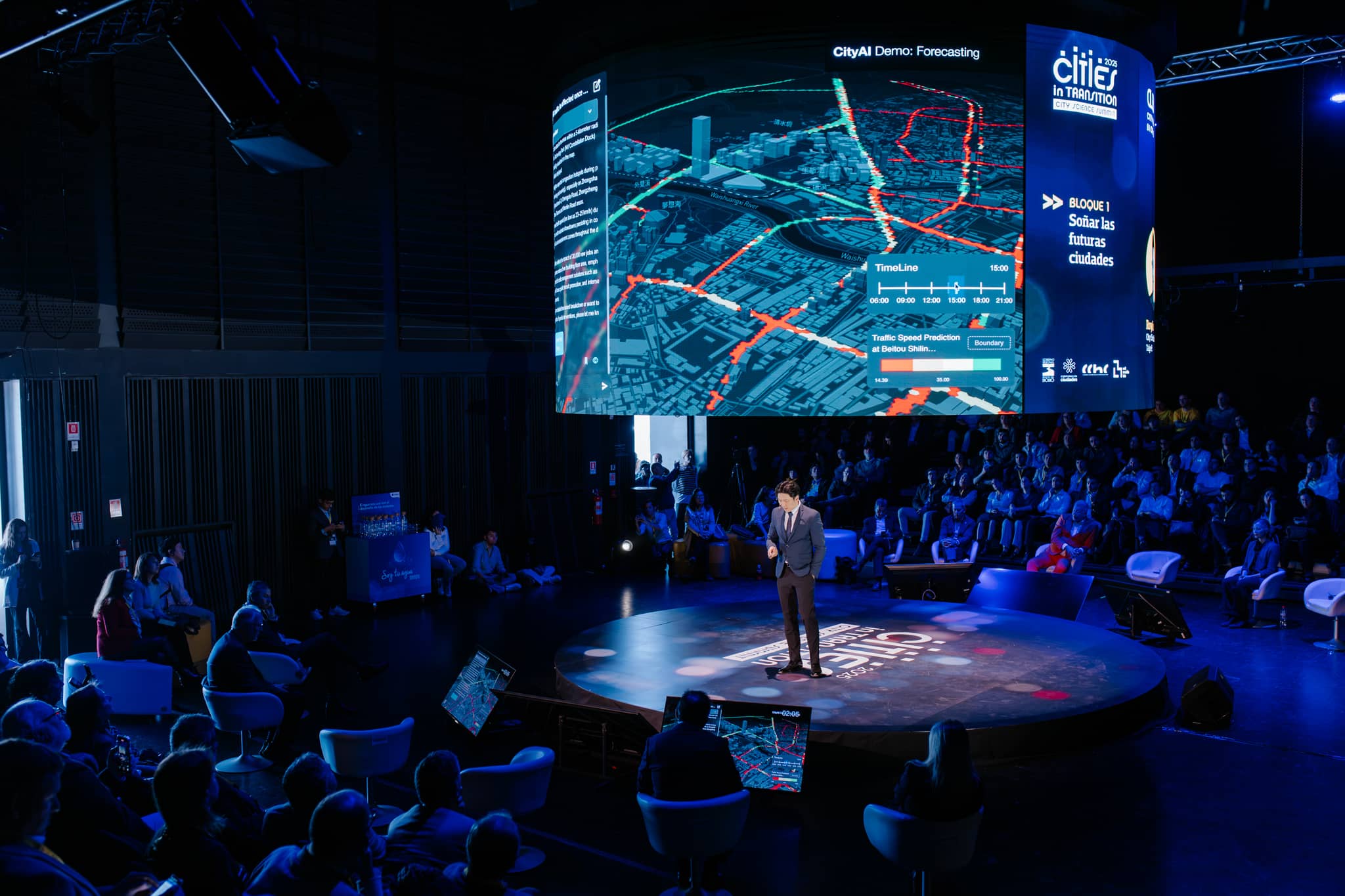
With a well-received opening performance by the group Echomusic — a dance show symbolizing the evolution of cities — the public session of the “Cities in Transition” Summit took place this Wednesday at Teatro Biobío. The event, organized this year by City Lab Biobío, is the annual gathering of the MIT City Science Labs network and brought together nearly 2,000 attendees.
The event brought together two leading creatives from Pixar Animation Studios, researchers from eight countries, companies, and representatives from the Chilean Chamber of Construction (CChC), the Regional Government, and Corporación Ciudades, among other participants. They shared their perspectives on how we imagine the cities of the future and the role technology and science can play in shaping them.
One of the most anticipated presentations came from Kristian Norelius, an art director at Pixar, and Amy Allen, a sets supervisor at the studio. During their talk, they explained how cities are built in iconic films such as “Coco,” “Cars,” “Inside Out,” and “Toy Story,” covering everything from early conceptual design to the final visual implementation.
They also shared a personal exercise in which they set out to design a “city for humanity,” created specifically to present during the Summit.
According to their vision, cities should prioritize natural light, access to clean air and water, and the presence of natural soundscapes. “We imagine a city without cars, relying instead on public transport and scooters; a community center that brings together science, spirituality, and culture; and buildings that function as biosystems, collecting rainwater and growing food.”
“I know everyone today is talking about artificial intelligence, but I think it’s important to step back and look at what’s essential. I would love to see a world that slows down a bit,” the art director reflected.
Fernando Pérez, principal director of City Lab Biobío, echoed that reflection, emphasizing that the focus must remain on people. “Here we aim to strengthen the idea of smart citizens, people who are able to use technology in meaningful ways to improve their decision-making processes and their quality of life.”
“Advanced technology is of little use if citizens are not able to incorporate it into their everyday decisions,” he added.
From a mobility perspective, Zuriñe Varela, scientific director of the City Science Lab Gipuzkoa, described cities as a backbone of interconnected mobility that requires collaboration across the entire community to function effectively.
To better understand how to design commuting strategies, for example, the Spanish lab developed a system based on a “digital twin” that simulates travel patterns in detail, with the goal of creating a region where destinations can be reached within 30 minutes by public transport. Achieving that, she noted, requires coordinated logistical planning across the community.
“Traditionally, studies have been a compilation of numbers and statistics calculated for each municipality,” Varela explained. “What we’re finding now, however, is that new methodologies move beyond municipal boundaries and focus more on specific places and how they function.”
Using that information, the team developed a method to help understand how different interventions “could influence the system and move cities closer to the future scenario they aim to achieve.”
Why anticipation matters.
Biobío Regional Governor Sergio Giacaman highlighted the contribution of City Lab Biobío. “Our expectation is that it becomes part of the solution to the challenges facing our cities. It’s important for our region to work with one of the world’s leading universities, such as MIT, and for scientists from the region and around the world to help find answers to the urban complexities we face,” the governor said.
Alfredo Echavarría, president of the Chilean Chamber of Construction, also highlighted the value of being able to model scenarios using urban data. “Any project we want to carry out takes years, and City Lab Biobío allows the preliminary studies and analysis to be done much more quickly. Citizen participation can also happen in a more agile way, with simulations that show the impacts of certain developments almost in real time,” he said.
The second day of the Cities in Transition Summit also featured presentations from researchers at partner labs in Taipei, Shanghai, Gipuzkoa, Hamburg, Andorra, and Guadalajara, along with other prominent national and international speakers.
City Lab Biobío operates in Greater Concepción thanks to the support and funding of the Biobío Regional Government and the Chilean Chamber of Construction, with operations carried out by Corporación Ciudades. It also receives strategic support from the University of Concepción, the University of Bío-Bío, and Universidad del Desarrollo, along with partnerships with public institutions and private companies.