

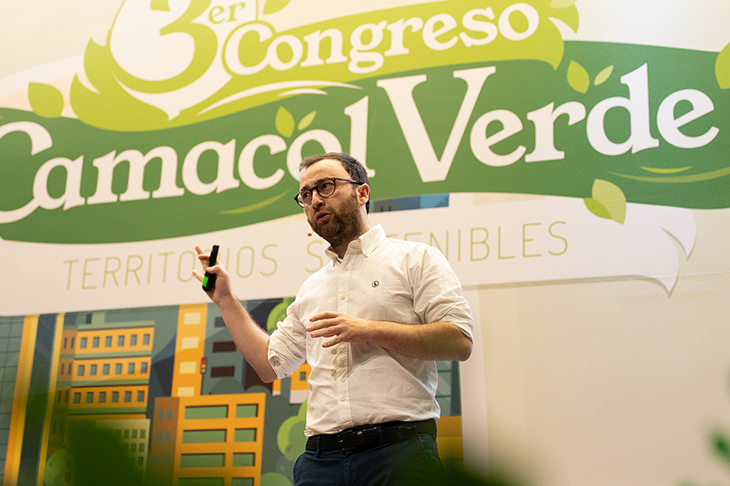
The third edition of the Camacol Verde 2025 Congress took place in the Colombian city of Bucaramanga, bringing together construction companies, government bodies, academics and all key stakeholders involved in the sustainability of the construction sector.
Since 2022 the event has been organised by the Colombian Chamber of Construction, Camacol, which that year laid out the guidelines of its climate action policy under the Camacol Verde banner, with the aim of unifying collective efforts, strengthening communication with the sector’s key players and leading the country’s drive to meet its environmental targets.
One of the platforms for showcasing that work is precisely this congress, which in its third edition was held on 8 and 9 May — previously staged in the cities of Pereira and Cali — to take stock of the advances and challenges of sustainable construction in Colombia.
Under the theme “Sustainable Territories,” the congress aimed to generate knowledge, drive business innovation and promote the use of circular economy strategies, emerging technologies and responsible practices that strengthen the sustainability and adaptability of cities and communities.
City Lab Biobío at the Camacol Verde 2025 Congress
City Lab Biobío’s work in developing anticipatory models for urban planning has attracted close attention in Colombia. For this reason, its executive director, Fernando Pérez, was invited to present at the congress on the analysis and projection of urban scenarios using CityScope technology, developed in cooperation with MIT, the Regional Government of Biobío, the Chilean Chamber of Construction in Concepción and Corporación Ciudades.
“The experience in Concepción has the potential to become a reference point for other cities in the region. While we may share some urban challenges and differ markedly in others, we do share the ability to analyse data in order to project forward. Science and technology make that possible today, even more so when working with those who hold world leadership in these fields, such as the researchers at MIT Media Lab. We believe this exchange of experience can be hugely valuable for cities that share common roots,” said Fernando Pérez, principal director of City Lab Biobío.
CityScope platform is built on complex logical systems and map and indicator visualisation, and uses thousands of LEGO pieces assembled to represent a study area to scale as its physical interface. The science behind CityScope makes it possible to visualise the impact of projects applied to cities, generating hundreds of different interactions between current and future scenarios. The full scope of this technology was presented in detail at the congress in Colombia.
“Transforming our cities begins with understanding them, and from that perspective the work of City Lab Biobío in Chile — grounded in data, science and citizen participation — is a very interesting path that we are watching closely as we work to build more just, sustainable and liveable urban environments for everyone,” said Katherine Bobadilla, director of Productivity and Sustainability at Camacol Nacional, following Pérez’s presentation.
Bucaramanga, known as the “City of Parks” and the “Beautiful City,” is distinguished by its abundant green spaces and is considered one of the most verdant cities in Colombia. The city reflects a clear commitment to sustainable urban development and the wellbeing of its residents, values that align directly with the objectives of the Camacol Verde 2025 Congress. Attendees also took keen interest in what will unfold later this year in Concepción, which will host the largest global gathering of MIT network urbanists at the Cities in Transition Summit — bringing together 150 specialists from ten countries between 7 and 9 October, organised by City Lab Biobío. It will be the first event of its kind held in the Southern Hemisphere.