

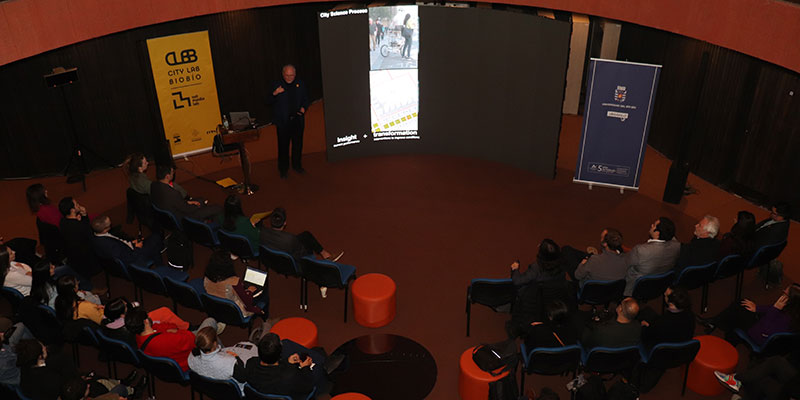
- The prominent American researcher, who directs MIT’s globally recognised network of urban laboratories, is leading a delegation of nine researchers now in Concepción to engage with the local community around the establishment of City Lab Biobío. In the city they inaugurated the laboratory’s headquarters, and in Santiago they met with students, urban planners, the Chilean Chamber of Construction, civil organisations, former authorities and Biobío Governor Rodrigo Díaz.
Concepción, 4 May 2023. The Universidad Católica and Universidad del Desarrollo in Santiago served as venues for two talks by the leading MIT researchers who will remain in Chile through Saturday. Around 100 students and representatives from various organisations were able to hear directly from Kent Larson, director of MIT’s City Science Group, and Luis Alonso, the group’s principal researcher and supervisor of the Chilean project.
“We promote community-scale solutions to address global urban challenges, and in all of these proposals technology at the service of people is fundamental,” said Larson, who presented a range of initiatives including robotic architecture to improve the quality of life of those living in small dwellings, more sustainable light-scale mobility, and examples of collaborative work across countries as diverse as Germany, the United States and Vietnam — delivering urban responses to complex situations such as the reception of migrants, street safety and pollution.
“Without communities, technology is just more technology — not smart urban planning. We can model everything that can be captured in data, but what matters most is articulating all those enormous flows of information to achieve a global, systemic view, with the city’s residents at the centre of the analysis and recommendations,” said Larson.
Environmental concerns ran through both Larson’s and Alonso’s presentations. The latter noted that 80 per cent of CO2 is produced in cities, but also that 80 per cent of innovations are developed in them. “Cities are great, but they also represent a major challenge. That is why we have to work collaboratively — even with those who think differently, even with those I don’t get along with. Historically we have stored human knowledge in silos, and what we do at MIT is connect those silos to help each community find its own innovative solutions. Many people think technology will solve everything, when what truly drives humanity and cities forward is mutualism — working collaboratively while recognising the legitimate goals of others,” said Alonso.
A new lab for Concepción
The MIT delegation took part in the inauguration of City Lab Biobío’s headquarters, which will operate out of the Regional Government building. The ceremony was led by Governor Rodrigo Díaz and was also attended by Juan Armando Vicuña, national president of the Chilean Chamber of Construction, Patricio Donoso, president of Corporación Ciudades, regional councillors and other stakeholders connected to the project. All of them highlighted the significance of this public-private partnership, which seeks to promote neighbourhood-scale urban solutions through technology and innovation.
Along the same lines, the regional governor reflected on urban projects that often stall due to conflicting interests or simply the lack of a specific methodology. “That is why it is reasonable to innovate in this area. If we cannot tackle these initiatives separately, there is an opportunity in public-private cooperation with academia. It is with this awareness that we sought a world-class alternative — because MIT is the most relevant innovation institute in the world,” said the regional authority.
The City Lab Biobío premises, located in the Regional Government building, feature large windows that connect the space visually with the outside world — a detail highlighted by director Marcela Martínez as a reflection of the community-facing character that will define the laboratory’s work. “This will be a welcoming, open space where citizens can engage with technology, science and research. We are an open laboratory, we work collaboratively, and if other universities want to join our network, they are very welcome,” said Martínez, acknowledging the significant contributions already being made by the Universidad del Bío-Bío, Universidad de Concepción and Universidad del Desarrollo.
With City Lab Biobío up and running, Greater Concepción joined a network of urban laboratories that already includes cities such as Hamburg, Shanghai, Taipei, Ho Chi Minh City, Toronto, Andorra and Guadalajara. This global connection was highlighted by Juan Armando Vicuña, national president of the Chilean Chamber of Construction, who said: “Good initiatives transcend borders, regardless of where they are. If this is done well in Concepción, it could be taken to other cities in Chile — and the world is watching us through MIT.”
Finally, Patricio Donoso, president of Corporación Ciudades, underscored the long-term vision behind the project: “When we talk about how we want cities to become places of opportunity, the solutions are not simple — they are complex, but above all they require a medium and long-term perspective. That is at the heart of this project: looking toward that horizon with the citizen at the centre,” he concluded.
The objective of City Lab Biobío is to strengthen housing planning and sustainable urban development through the implementation of tools and methodologies that enable real-time, to-scale simulations, built from data gathered jointly with communities and relevant public and private stakeholders.
On Thursday the MIT researchers visited the Costanera district of Concepción, announced three weeks ago as the first area to be studied and modelled by City Lab Biobío.
Greater Concepción is Chile’s second largest metropolitan area, with 971,285 inhabitants and an urban population exceeding 951,000 — 98 per cent of the total. Yet only 23.7 per cent of its population lives in areas considered high-wellbeing, while 18.5 per cent live in deprived zones and 9.4 per cent in areas designated as priorities for public investment.
Media inquiries with: Enrique Barrera, Cel. +56997420472.